
A newly discovered Sony patent outlines how the company could reduce input latency in future gaming systems by combining AI prediction models with additional sensor technology.
Sony debuted its proprietary PlayStation Spectral Super Resolution (PSSR) upscaling technology with the PlayStation 5 Pro. While this solution effectively upscales lower resolutions to 4K, modern graphics enhancements like frame generation typically introduce increased input lag. This creates a scenario where higher frame counts don't necessarily translate to more responsive gameplay.
Industry leaders AMD and Nvidia have addressed similar challenges with their respective Radeon Anti-Lag and Nvidia Reflex technologies. Now, Sony appears ready to develop its own unique approach to minimizing latency.
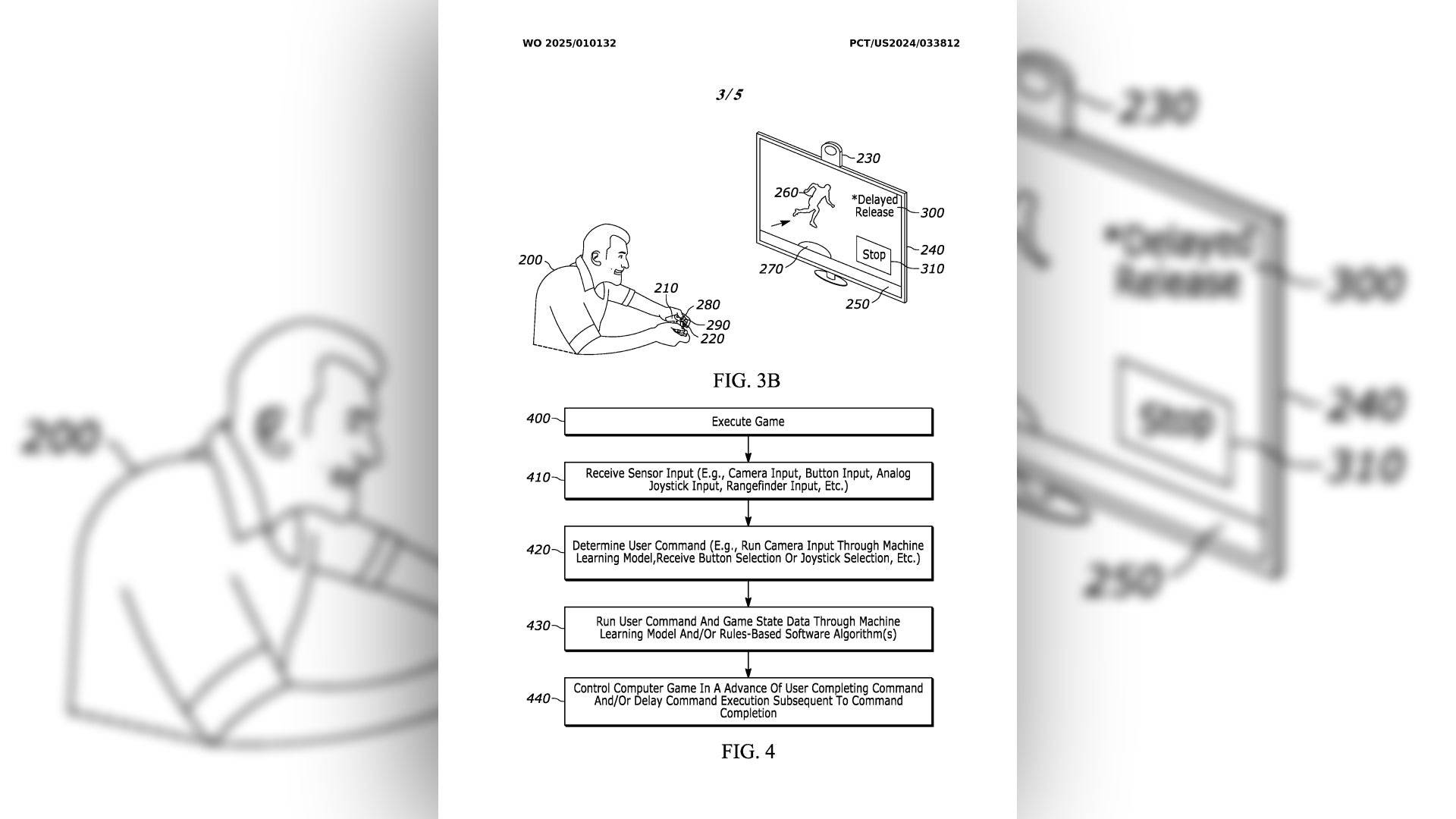
First identified by Tech4gamers, Sony's patent WO2025010132 ("TIMED INPUT/ACTION RELEASE") proposes a system designed to predict and optimize the execution timing of user inputs. The technology aims to anticipate player commands before they're physically registered.
Sony's patent application explains: "There exists inherent latency between a user's input action and the system's processing and execution of that command. This delay can cause both delayed execution and unintended gameplay consequences."
The proposed solution features multiple interconnected components: an AI prediction model that forecasts upcoming inputs, combined with external sensors. One implementation example involves using a camera to monitor controller inputs before they're physically pressed. The patent states: "In one configuration, the method incorporates camera input as data for a machine learning model, where the camera input anticipates the user's initial command."
An alternative implementation could utilize pressure-sensitive controller buttons themselves as input sensors. Given Sony's history with analog input buttons in previous controllers, this approach could potentially feature in next-generation hardware designs.
While the exact implementation may differ from the patent description when (and if) it reaches PlayStation 6 (as patent filings often evolve during development), this clearly demonstrates Sony's commitment to reducing latency without compromising responsiveness. This becomes especially relevant as frame generation technologies like FSR 3 and DLSS 3, which inherently increase system latency, gain wider adoption.
Such technology would prove particularly valuable in competitive gaming scenarios like fast-paced shooters that demand both high frame rates and minimal input delay. Whether this specific patent manifests in future hardware remains uncertain, but it undoubtedly reflects Sony's focus on enhancing player responsiveness in next-generation systems.