
A two-player board game
Mancala games are a category of two-player, turn-based strategy board games played with small stones, beans, or seeds placed in rows of holes or pits on a board, the ground, or another playing surface. The goal is typically to capture all or a certain number of the opponent's pieces. (Wikipedia).
The mancala family includes many games such as oware, bao, omweso, and others.
This is an implementation of several mancala games, including kalah, oware, and congkak.
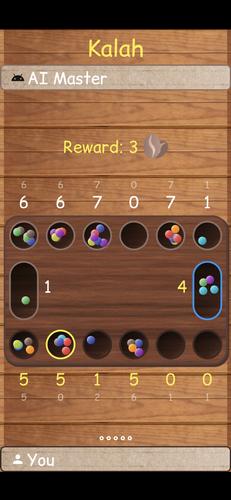
The game includes a board and a set of seeds or counters. The board features six small pits, known as houses, on each side, plus a large pit called an end zone or store at each end. The objective is to collect more seeds than your opponent.
Kalah Rules:
1. At the start of the game, four to six seeds are placed in each house.
2. Each player controls the six houses and their seeds on their side of the board. A player's score is the number of seeds in the store to their right.
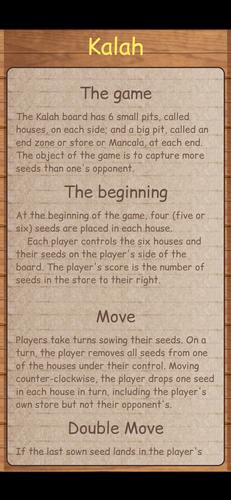
3. Players alternate turns sowing seeds. On a turn, a player removes all seeds from one of their houses. Moving counter-clockwise, they drop one seed into each subsequent house, including their own store, but not the opponent's store.
4. If the last seed sown lands in an empty house owned by the player, and the opposing house contains seeds, both the last seed and the seeds in the opposite house are captured and placed into the player's store.
5. If the last seed lands in the player's store, that player gets an extra turn. There is no limit to the number of consecutive moves a player may make.
6. The game ends when one player has no seeds left in any of their houses. The other player then collects all remaining seeds into their store, and the player with the most seeds wins.
Oware Rules:
1. At the beginning of the game, four to six seeds are placed in each house. Each player controls the six houses on their side. A player's score is the number of seeds in the store to their right.
2. On a player's turn, they pick up all seeds from one of their houses and sow them one by one counter-clockwise into subsequent houses (a process called sowing). Seeds are not sown into the scoring stores or the house they were taken from. The starting house is left empty. If it held 12 or more seeds, it is skipped, and the 12th seed goes into the next house.
3. Capturing happens only when a player's final sown seed makes an opponent's house contain exactly two or three seeds. This captures all seeds in that house. If previous seeds also brought opponent houses to two or three seeds, those are captured too, continuing until a house does not meet the condition or is not owned by the opponent. Captured seeds go into the player's scoring store.
4. If all of the opponent's houses are empty, the current player must choose a move that gives seeds to the opponent. If no such move exists, the player captures all seeds on their side, ending the game.
5. The game ends when one player captures over half the seeds, or if both players capture half (resulting in a draw).
What's New in the Latest Version 1.4.1
Last updated on Aug 6, 2024 - Bug fixes